

Supporting Microbiology Services in India

Building on Ivor Mitchelmore’s (Chief Biomedical Scientist (Retired) Luton & Dunstable University Hospital), long-standing work at Khristiya Seva Niketan Hospital (KSN) Hospital in rural West Bengal, Ivor and David Westrip recently returned together to take the next step in developing the hospital’s microbiology service. With support from Mast Group, who have been involved since Ivor reached out to diagnostic companies in 2020, the latest trip focused on setting up antimicrobial resistance (AMR) testing. It was another practical and positive step towards strengthening local laboratory services and supporting safer, more informed treatment for the communities served by KSN Hospital.
Antimicrobial resistance is of significant global concern and in the literature, India is frequently highlighted as an area of concerningly high resistance levels. The reasons for this are well documented but one thing which is not always easy to determine from the available data is more regional and local resistance patterns. Whilst national data is available few studies have looked at regional or local resistance patterns. Even within the UK carbapenem resistance in Gram negatives seems of higher prevalence in large urban populations and much lower in remote or rural communities. India is approximately 13 times larger and is considerably more geographically and socially diverse


David Westrip MSc Sci MIBMS, shares insight into the creation of Microbiology services at Khristiya Seva Niketan Hospital with the support of Mast Group
David Westrip MSc CSci MIBMS. BSMT Chair and Locum Biomedical Scientist, Western Isles of Scotland.
After qualifying as a Biomedical Scientist (BMS) at the Luton and Dunstable Hospital, David has since worked across a number of NHS Trusts. As his career has progressed, he has had the opportunity to take on a variety of different responsibilities with a focus on training and laboratory quality systems. Now with over 20 years' experience in microbiology, he is currently working as a locum BMS in the Western Isles of Scotland whilst scouting for other interesting roles.
In 2025 I visited as part of a small group and with the generous support of MAST was able to collaborate with the local technical staff to introduce some screening for resistance mechanisms. Using the Mast D72 and D73 discs we initially tested 45 isolates derived from urine cultures to assess the predominant resistance patterns in the local population. From this initial testing we were able to determine that around 38% (17/45) exhibited some form of resistance mechanism the overwhelming majority of which was AmpC (13/17). Other findings including ESBL (2/17) carbapenemase activity (1/17, confirmed as NDM) and ESBL/AmpC co-expression (1/17).
Through collaboration with the local staff, we were able to provide training in this new method and introduce it into routine use. Using Meropenem and Cefpodoxime discs as an initial screen for resistance and then confirming using the D72 and D73 discs we were able to introduce a sustainable and reliable method to provide better susceptibility data to the medical staff. It’s true that the numbers in this study were small and only represent a small snapshot of the situation. Nonetheless, it provided useful data which we were able to feed directly back to the medical teams which will allow them to make more informed prescribing decisions.


Overall, the MASTDISCS® and media performed reliably and consistently in a challenging and remote location. By introducing this simple 2 stage screening protocol we were able to reliably determine all the major resistance mechanisms in Gram negative bacteria. These discs are widely used throughout the UK and have been shown to be a reliable and robust test. Whilst challenges remain regarding ensuring appropriate QC and quality assurance is in place in remote laboratories, I am confident of the results we obtained and the pragmatic solution these confirmation discs represent in this environment.
I would like to thank Mast for supporting this project and acknowledge the skill, experience and commitment of the local team who fully embraced this new challenge and without whom the hospital service would be greatly depreciated.’
- 1
Mast Group's connection with the BSMT goes back to its beginnings in 1985, following a meeting hosted by our late founder and Managing Director, Mr John Oliver. Since then, Mast has remained closely involved, and continues to support its work year on year. This long-standing relationship reflects Mast’s commitment to sharing knowledge, supporting laboratory development and strengthening clinical microbiology practice.
Related Products
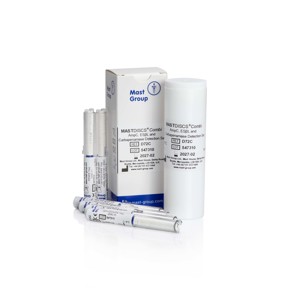 More infoIdentification & DetectionMASTDISCS® Combi AmpC, ESβL and Carbapenemase Detection SetD72CMASTDISCS® Combi six cartridges for the detection of AmpC and/or Extended Spectrum Beta-Lactamases (ESβL) with confirmation of inducible AmpC and carbapenem resistance status in Enterobacterales:Cartridge A: Cefpodoxime 10µgCartridge B: Cefpodoxime 10µg + ESβL inhibitorCartridge C: Cefpodoxime 10µg + AmpC inhibitorCartridge D: Cefpodoxime 10µg + ESβL inhibitor + AmpC inhibitorCartridge E: Cefpodoxime 10µg + ESβL inhibitor + AmpC InducerCartridge F: Penem Antibiotic*Please login to download the calculator for this product
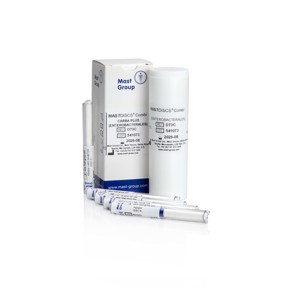 More infoIdentification & DetectionMASTDISCS® Combi Carba PlusD73CMASTDISCS® Combi five cartridges for the detection of carbapenemase and OXA-48-like enzyme production in Enterobacterales:Cartridge A: Penem discsCartridge B: Penem + MβL inhibitorCartridge C: Penem + KPC inhibitorCartridge D: Penem + AmpC inhibitorCartridge E: Temocillin + MβL inhibitor*Please login to download the calculator for this product
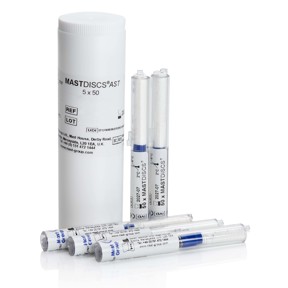 More infoASTMeropenem 10µgMEM10CMASTDISCS® Antibiotic Susceptibility Test Discs are high-quality paper discs impregnated with specific antibiotics for the determination of susceptibility of common bacterial pathogens using disc diffusion testing methods. MASTDISCS® deliver reliable and consistent results in routine microbiology laboratories. Each pack contains 5 cartridges of 50 discs.
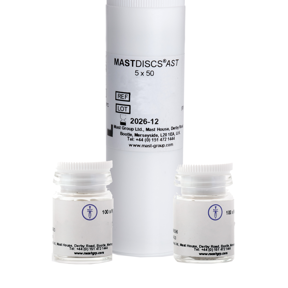 More infoASTCefpodoxime 10µgCPD10CMASTDISCS® Antibiotic Susceptibility Test Discs are high-quality paper discs impregnated with specific antibiotics for the determination of susceptibility of common bacterial pathogens using disc diffusion testing methods. MASTDISCS® deliver reliable and consistent results in routine microbiology laboratories.